
The Red Cell Network has produced two new documents to help patients and families better understand thalassaemia care, feel more confident, and know what to do in both everyday and urgent situations.
One guide focuses on when your child may need urgent medical attention: ED Advice for Kids
The second document explains the regular monitoring needed for people living with thalassaemia. These tests help us check blood levels, iron levels, and how well organs like the heart, liver, kidneys, and bones are working. Thalassaemia Patients - Your Long Term Monitoring
These new resources are designed to help you feel informed, reassured, and involved in your care. By understanding what to look out for and why monitoring matters, you can play an active role in staying as healthy as possible.
In June 2022, Dr Olu Wilkey (NMUH) and Dr Andrea Leigh (UCLH) successfully hosted an NCL community engagement event at Tottenham Hotspurs’ Stadium. The event was engaging, informative and well attended, with lots of input from healthcare professionals and charities. Watch the Q&A session with the Expert Panel.
To mark World Sickle Cell Day 2023, Anthony Nolan have shared their brand-new resource for people with sickle cell disorder considering a stem cell transplant. Having a stem cell transplant has been a possible treatment option for adults with severe sickle cell disorder in the UK since 2020.
As it is the only curative treatment option currently available, it’s likely patients will have questions whether this could be an option for them.
Please visit Anthony Nolan's dedicated web page for sickle cell disorder.
The Sickle Cell Society have released a useful video on Priapism and what to do if you experience it. To watch the video and for further information, please visit A Simple Guide to Priapism.
The Red Cell Network held a research information session which was open to all red cell patients who wanted to learn more about the research process. The session was a huge success and gave patients the opportunity to ask questions freely, and air any concerns they had about becoming engaged with research.
In the second part of the session Eliane Young, a psychologist from Addenbrooke's hospital in Cambridge, talked about a study which focuses on the psychology associated with getting older and living with sickle cell disorder. It is the first of its kind in the UK, and will be open initially to patients in the East Anglia and North Central London region. View the full recording of the patient information session.
- Psychological support for adults with red cell disorders
- Guide to services for people with red cell and iron disorders
- Automated red cell exchange for patients with sickle cell disorder
- Femoral lines for red cell exchange
- Community sickle cell and thalassaemia services
- Desferal treatment for iron overload
- Deferasirox treatment for iron overload
- Glucose-6-phosphate dehydrogenase (G6PD) deficiency
- Hydroxyurea for treatment of sickle cell disorder
- Incentive spirometry
- Medications, vaccinations and travel in sickle cell disorder
- Priapism in patients with sickle cell disorder
- Sexual health, contraception and preparing for pregnancy
- Sickle cell disorder and pregnancy
- Sickle cell disorder in adulthood
- Sickle cell disorder in children
- Information for Sickle Cell Disorder patients who may need a blood transfusion
- Transcranial dopplers (TCD)
- Treatment options for iron overload
- Hereditary spherocytosis
- Alpha thalassaemia
- Medications, vaccinations and travel in thalassaemia
- Thalassaemia and pregnancy
- Thalassaemia (transfusion-dependent and non-transfusion-dependent)
For some short, informative videos on Nutrition from Dr Matthews, please check these videos out. For more detailed videos on nutrition in sickle cell and thalassaemia, please see the videos lower down on this page.
The Improving Black Health Outcomes (IBHO) BioResource is a research programme which invites individuals from Black ethnic backgrounds to participate in research focused on improving knowledge and understanding of health conditions and their unique impacts on UK Black communities. The below video features volunteers joining the IBHO BioResource at UCLH sharing their motivations for taking part in research, including personal stories of living with or someone in the family living with Sickle Cell. Visit this link to register your interest.
NHS Blood and Transplant are actively looking for patients' consent for the Sickle Cell and Thalassaemia Blood Group Genotyping Programme. Below are some answers to commonly asked questions about the programme - for further information, please visit the genotyping page on the NHSBT website, or speak to a member of your clinical team.
What are blood groups and what is blood group matching?
Red blood cells have labels on their surfaces, know as antigens or blood groups. We inherit our blood groups from our parents and different people have different blood groups. There are over 300 different blood groups, although the most important/well know ones are A, B, O and AB. These are known as the basic blood groups. The donor blood selected for transfusion matches basic blood groups as standard. Blood for people with thalassaemia and sickle cell is matched for a small number of additional groups but it is not matched for the full extended blood groups.
How is blood matched now?
Before a person receives a transfusion, they have a blood sample taken, which will be processed by a hospital laboratory to check their basic blood group if they are “regular” patient. For someone with thalassaemia or sickle cell, they would have their partially extended blood group checked. When the blood laboratory team choose blood for patients, they check that the blood group of the donor matches their blood groups as closely as possible.
How do NHSBT find out the blood groups for donors and patients?
NHSBT uses a technique involving antibodies, known as serology, to detect blood groups. This works well for basic blood groups, but for testing more of the blood groups (known as extended blood group testing) a different technique is needed. This is because serology is time-consuming, expensive and they do not have the antibodies or resources to test all different blood groups of patients and donors.
Why would it help to perform extended blood group testing on our patients and donors?
Each time a person is transfused, even if the basic blood group is matched, there is a chance that the person can form a new antibody if the extended blood groups are not matched. Antibodies can cause reactions which may be severe and make it difficult to find the right blood for patients in the future. Unfortunately, this happens more often for people with thalassaemia and sickle cell.
What is the new technology?
Blood groups can also be tested using DNA from blood samples. This is known as blood group genotyping. NHSBT has used this technology for a while but up until now, it has been a slow and expensive test. Working with an international group of scientists and industry, NHSBT has developed a new fast and cost-effective test. NHS England are funding NHSBT to offer this new test alongside testing for bone marrow type, called the Sickle Cell and Thalassaemia Blood Group Genotyping Programme.
How would this new technology help patients?
NHSBT is running a similar programme in blood donors. Using the blood group types from donors and patients should allow the NHS, in the future, to provide the best possible blood match for patients, reducing the risk of forming antibodies. For those patients that already have antibodies, it should be easier and quicker to find suitable blood for transfusion. By also testing HLA, people who are potentially eligible for the stem cell / bone marrow transplant will have taken the first step to see if they have a related HLA-matched donor. We can’t say when we expect extended matching to be available for those patients who may benefit. But as more of the patients and donors have their blood group genotyped, it will be increasingly possible to provide better matched blood.
How can I have my thalassaemia blood group genotyping test done? What is involved?
The blood group genotyping test requires a single sample tube of blood that can be taken at the same time you have a blood test. However, it can only be taken in hospital. The test will be explained to you and, if you agree, they will confirm your consent on the test request form. The samples and request form will be sent to NHSBT for testing. The result will be available to the hospital laboratory team on the regular system they use to access NHSBT results. In many hospitals, the team will put the results on the hospital laboratory system so your clinical team can see these results and share them with you.
Following testing, there is often some of your blood sample left over. The law allows NHSBT to use this, and the information associated with it, anonymously for quality control (making sure the tests are working correctly), education or training relating to the human health, or ethics committee-approved research. Samples may be stored as part of required archiving protocols to enable further investigation for your benefit. This practice helps NHSBT maintain accurate testing procedures and improve its knowledge, and so provide the best possible care for all our patients now and in the future. If you do not want your sample to be used for these purposes, you should tell your clinical team so that they can tell NHSBT. NHSBT will respect your wishes and dispose of any samples they no longer need.
In this hour long documentary, Chanel Jay uncovers the realities of living with sickle cell disorder. Through powerful and emotional stories, we hear from: Samantha, a mother who tragically lost her daughter Siobhan to sickle cell complications, Nicole, who lives with sickle cell and shares the struggles that come with it, and Sickle Cell Society. This film explores the pain, resilience, and hope of those affected, while shining a light on why awareness and support are urgently needed. Watch the film on YouTube here.
A video released by NHS England which highlights the lived experience of those with red blood cell disorders, and offers insight to healthcare professionals on how services can be made more responsive, inclusive, and accessible.
Exercise for Sickle Cell Disorder
The North-East and Yorkshire Haemoglobinopathy Coordinating Centre, Sickle Cell Society, and Cardiff and Vale have produced videos on exercise for sickle cell patients.
How exercise supported my sickle cell journey
Exercise advice for teenagers and adults living with sickle cell disorder
Core (trunk) exercises for teenagers and adults living with sickle cell disorder
Hip exercises for teenagers and adults living with sickle cell disorder
Knee exercises for teenagers and adults living with sickle cell disorder
Upper limb exercises for teenagers and adults living with sickle cell disorder
Nutrition in Sickle Cell Disorder
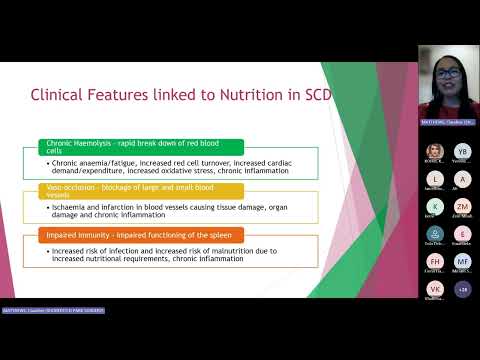
In Spring 2025, The Red Cell Network teamed up with the UK's leading dietitian for SCD, Dr Claudine Matthews. These 4 sessions provide expert insight into the impact of diet and nutrition for those living with the disorder. It is beneficial for patients, parents/carers and professionals alike.


Nutrition in Thalassaemia Webinar Series 2024
Dr Claudine Matthews delivers a 'world-first' series of workshops focused on nutrition in Thalassaemia on behalf of The Red Cell Network in partnership with the UK Thalassaemia Society. Get your pen and paper and check out the lectures to pick up a few pro tips.


Thalassaemia bitesize sessions


Menopause Awareness for Thalassaemia
The Red Cell Network has teamed up with Dr Vikram Talaulikar and Babita Paul from New Chapter Nutrition for Menopause to deliver this educational series.


London Zoo Event 2024
In October 2024, The Red Cell Network hosted a fantastic event at London Zoo for children and young people, and their loved ones, with red cell disorders. Below is the highlights video of the day, and the Expert Panel Q&A Discussions. The panel is hosted by Dr Andrea Leigh and features Dr Janine Younis, Chris Dean, Dr Ben Carpenter, Nneka Smith, Dr Kofi Anie, Dr Noemi Roy, Roanna Maharaj, and Dr Martin Besser.


